
3D technologies and printing applied to podiatry
In podiatry, 3D printing makes it possible to completely rethink how orthopaedic insoles are designed and made. Thanks to foot scanning, practitioners gain a detailed view of the morphology of the sole of the foot. 3D modelling then makes it possible to design orthopaedic insoles that meet the podiatrist’s requirements for comfort and precision.
Twin 3D supports podiatry practices and laboratories in this digital transition. We offer software solutions that support additive manufacturing and the use of suitable materials such as polyamide, ensuring reliable and safe medical devices for patients.
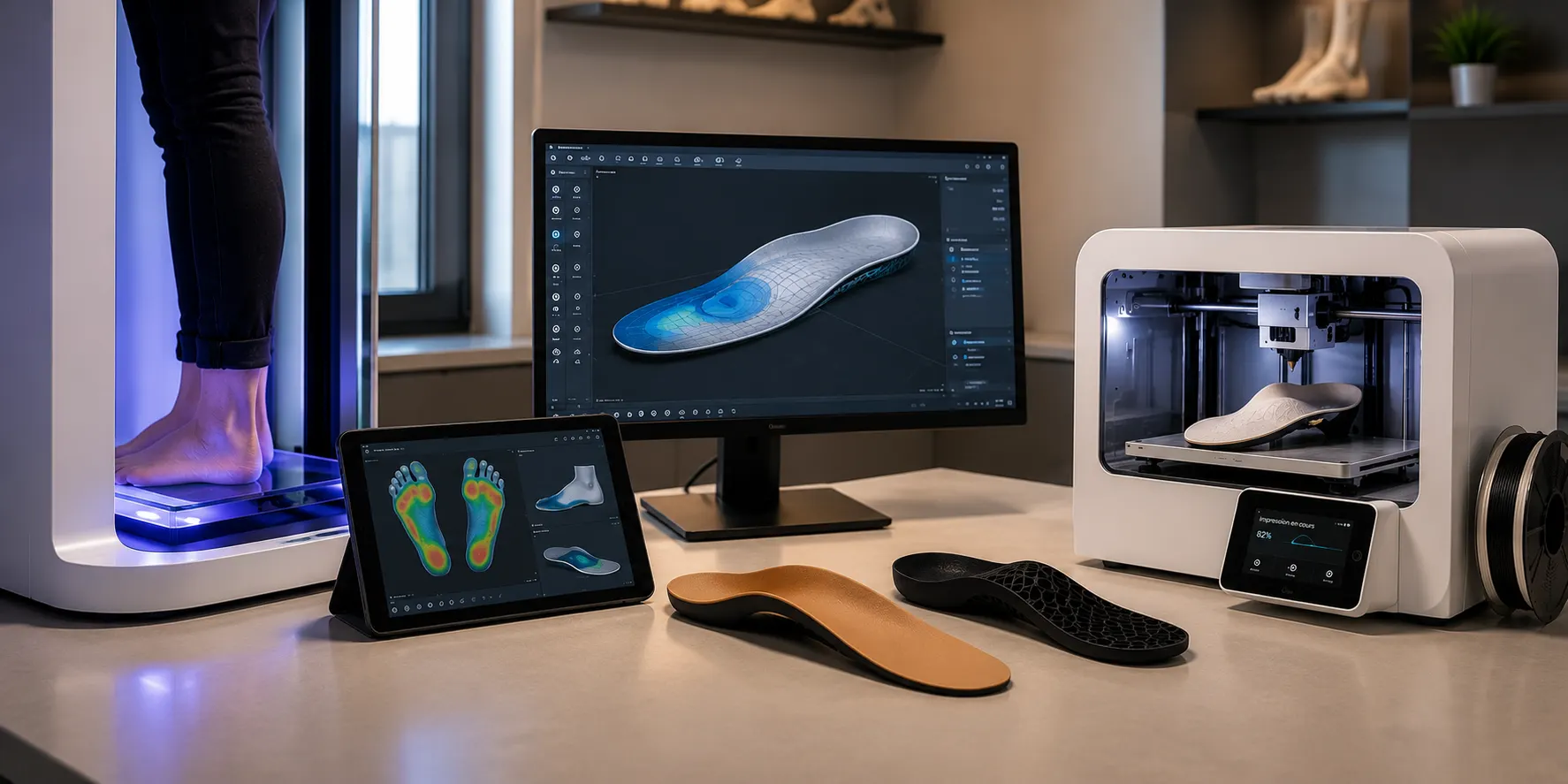
How does 3D printing work in podiatry?
Integrating digital technology into podiatry follows a multi-step process:
- Clinical examination and foot impression.
- 3D scan to capture the anatomy of the sole of the foot with precision.
- Software-assisted 3D modelling, allowing you to design and adapt the shape and the necessary corrections.
- Additive manufacturing: the 3D printer produces the device layer by layer to create the orthopaedic insole.
- Finishing and adjustments before fitting in the patient’s shoe.
This approach produces highly precise insoles, perfectly suited to the patient’s anatomy and condition, and incorporating all your innovation and clinical expertise
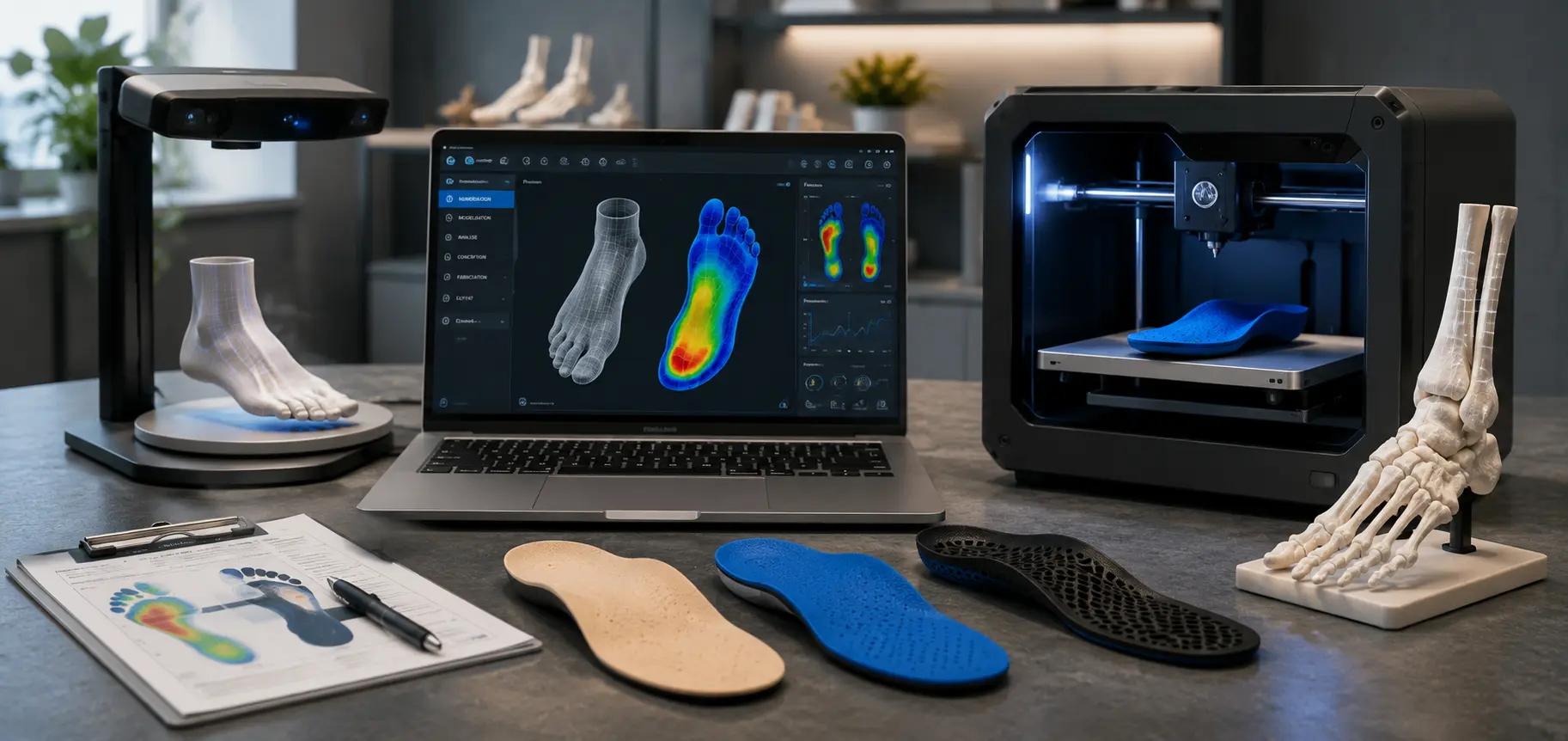
What are the benefits of 3D insoles?
Integrating digital technology into podiatry follows a multi-step process:

High precision
faithful reproduction of the anatomy of the sole of the foot.

Patient comfort
design adapted to the shape of the foot, ensuring a product that is comfortable every day.

Personalisation
correction of postural disorders according to specific needs. Pressure distribution in line with your clinical analysis.

Cost reduction
fewer trials, less wasted material, optimised working time.

Durability
use of durable materials such as polyamide, ensuring a long service life. Easier tracking of adjustments over time (digital traceability).
How do you model insoles in 3D ?
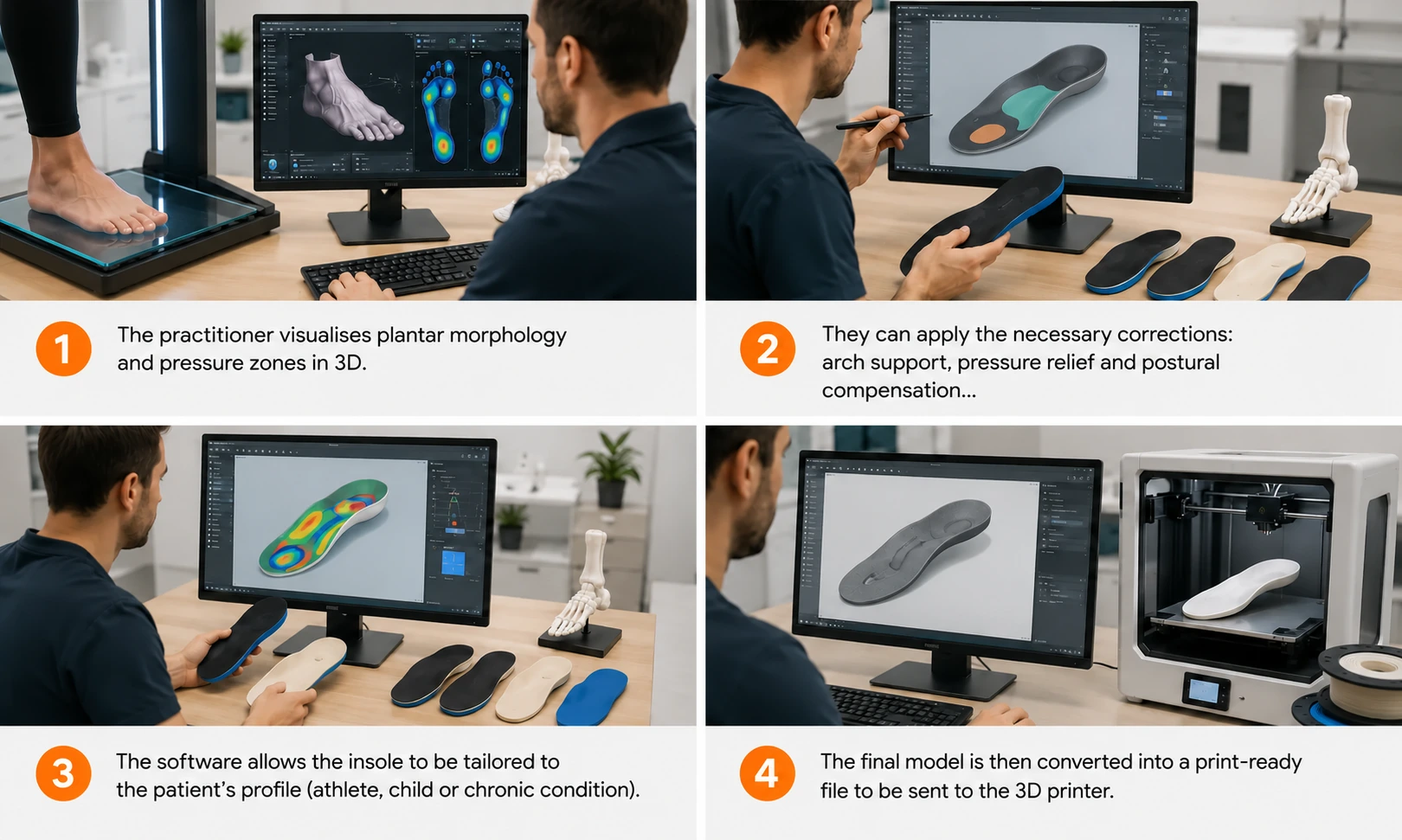
Once the foot has been scanned, the data is imported into podiatric design software.
This is where the podiatrist’s work becomes essential:
-
1
They view the morphology of the sole of the foot and the areas of stress in 3D.
-
2
They can apply the necessary corrections: arch support, added offloading, postural compensation…
-
3
The software makes it possible to adapt the insole to the patient’s profile (athlete, child, chronic condition).
-
4
The final model is then converted into a print file ready to be sent to the 3D printer.
What types of prostheses and orthoses can be created?
With 3D printing, it is possible to produce a range of orthopaedic devices according to clinical needs:

Prostheses for amputated limbs
(arm, leg, hand).
Foot orthoses
(3D orthopaedic insoles).

Splints and seating corsets
adapted to the patient’s morphology.

Functional parts
(e.g. sockets, structural components).

Innovative functional solutions
such as openwork, lightweight and ventilated designs.
What materials are used for 3D insoles?
Additive manufacturing of orthopaedic insoles relies on several materials suited to podiatry:
- Polyamide (PA12): strong, lightweight and flexible, it is commonly used for insoles intended for everyday use.
- Innovative lattice structures: produced by 3D printing, they combine lightness, durability and targeted support.
- Biocompatible resins used for certain devices in direct contact with the skin, they ensure tolerance and safety.
- Thermoplastic elastomers (TPU): soft and shock-absorbing, they provide greater comfort, particularly for athletes.
The choice of material depends on the type of orthopaedic correction, the patient’s profile (adult, child, athlete) and the mechanical demands of their activity.
How can the cost of orthopaedic insoles be reduced?
3D printing reduces the cost of orthopaedic insoles
thanks to:
- time saved in design,
- reduced material use,
- an optimised digital process
(scan → modelling → printing), - faster production than traditional methods.
For a podiatry practice, 3D printing saves time, limits adjustments and makes it possible to offer patients insoles of consistent quality.
What are the manufacturing times for 3D insoles?
In podiatry, manufacturing 3D orthopaedic insoles is much faster than traditional methods. After the clinical examination and foot impression, 3D modelling takes only a few minutes and directly generates a digital model ready for printing.
Additive manufacturing then takes over: the 3D printer produces a pair of insoles in just a few hours
Solutions offered by Twin 3D
Twin 3D supports podiatrists and specialist laboratories by providing:
- Certified software for scan clean-up and 3D design of orthopaedic insoles.
- Printed medical devices: 3D insoles, foot orthoses, anatomical models.
- Technical support and training to integrate 3D printing effectively into your workflow.
- Advice on materials and processes (polyamide, lattice structures, biocompatible materials).
Our goal: to provide healthcare professionals with reliable and innovative digital solutions in order to improve patient care.
FAQ
Yes. Twin 3D offers training tailored to podiatrists and their teams, so that 3D modelling and 3D printing can be integrated effectively into the clinical workflow.
Yes. Our software works with standard formats (DICOM, STL, OBJ) and is compatible with most foot scanners and equipment already in use in clinics or laboratories.
Patients benefit from more precise 3D orthopaedic insoles, designed from the shape of their own feet. The result: greater comfort, fewer trial fittings and faster treatment.
We offer several options: an annual licence with updates included, a perpetual licence for long-term use, or floating licences to share the tools across multiple workstations.
Other allied health specialities
They trust us









Book a demonstration
Twin 3D supports healthcare professionals in their medical 3D projects. Speak with an expert and discover our solutions during a demonstration.