
3D software and printing at the heart of medical research
3D software and printing are opening up new prospects for medical and scientific research. By combining digital modelling, computer-aided design (CAD) and additive manufacturing, they give research teams precise tools to speed up their studies and to design and validate new medical devices. Laboratories can thus create realistic anatomical models, study the behaviour of materials and prototype their concepts before industrialisation.
Twin 3D supports R&D departments, research centres, simulation centres, university hospitals and biomedical laboratories in integrating these technologies, providing solutions suited to applied research, experimental validation and technology transfer to the medical sector.
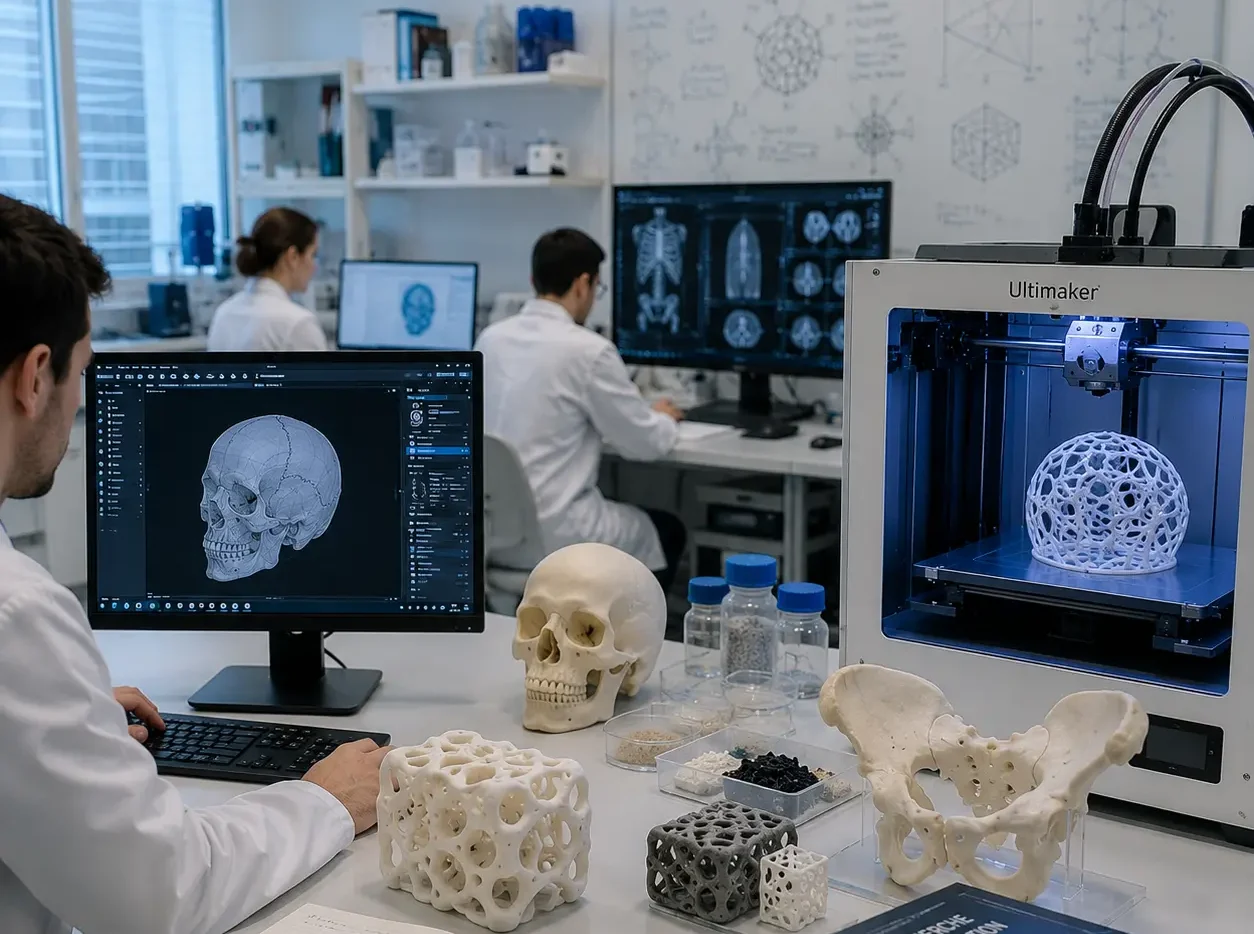
How do 3D technologies support medical research?
Software combined with 3D printing has become an essential lever for biomedical researchers and engineers:
- Rapid prototyping: creation and iteration of medical or surgical devices at lower cost, directly from research models.
- Anatomical and tissue studies: faithful reproduction of organs, tissues or complex structures for training, experimentation and scientific validation.
- Biomaterial development: exploration of polymers, resins and hydrogels for research into implants, prostheses or regenerative structures.
- Interdisciplinary collaboration: bringing medical, engineering and materials science teams together around shared projects.
These uses allow research centres to save time, improve experimental precision and strengthen the quality of medical studies.
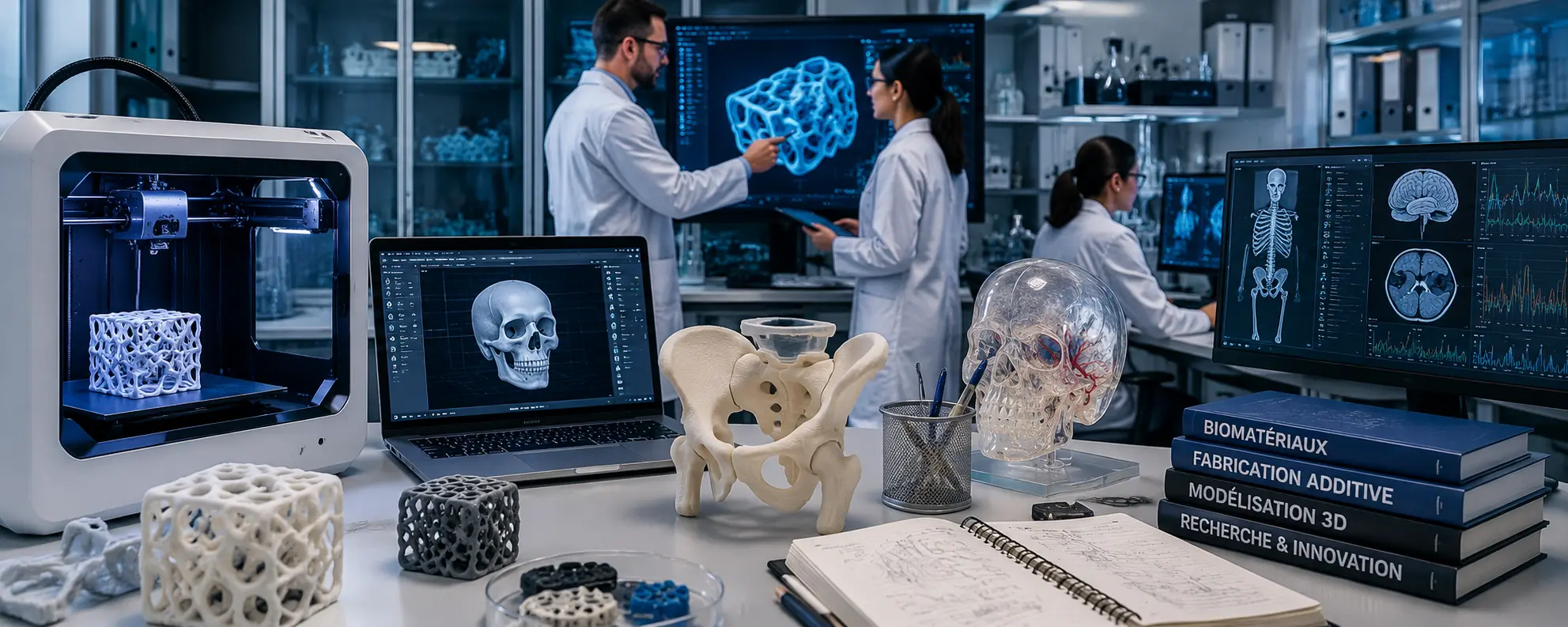
How does 3D printing support applied research?
Additive manufacturing eases the transition from fundamental research to clinical innovation:

Functional validation
printing of prototypes or technical parts to test the strength, biocompatibility or performance of devices.

Experimental simulation
use of printed anatomical models to prepare clinical trials or validate surgical protocols.

Reduced costs and lead times
fast, local production of parts reduces the need for subcontracting and speeds up development cycles.

Scientific documentation
3D modelling used to publish, share or archive research results in a visual and standardised way.
Which tools and materials for medical research?
Twin 3D provides laboratories with solutions designed for scientific precision and reliability:
- Segmentation, 3D modelling and computer-aided design (CAD) software: to create anatomical models, technical prototypes or experimental medical devices.
- High-resolution 3D printers: capable of producing parts with precise tolerances for the study of anatomical and biomechanical structures.
- Advanced materials: polyamides, photopolymer resins, biomaterials and hydrogels for work on implants, tissues or artificial organs.
- Technical and scientific support: assistance with setting up protocols, equipment maintenance, and support on collaborative research projects.
Thanks to these tools, Twin 3D helps research centres speed up their work, validate their prototypes and strengthen the synergy between science, technology and healthcare.
FAQ
Yes. Twin 3D offers training for engineers, technicians and researchers, enabling them to master design software and 3D printing processes applied to medical research.
An enhanced ability to innovate, validate and publish more quickly, thanks to precise design tools and low-cost local manufacturing.
Yes. Our tools integrate into research platforms and use standard formats (STL, OBJ, DICOM), compatible with the majority of medical software and scanners.
Yes. Twin 3D works with university hospital centres and public research laboratories on applied research and technology transfer projects.
Other players in research and training
They trust us









Book a demonstration
Twin 3D supports healthcare professionals in their medical 3D projects. Speak with an expert and discover our solutions during a demonstration.