
3D printing applied to ENT surgery
ENT surgery is undergoing a major evolution with the integration of 3D technologies. These innovations make it possible to plan procedures with greater precision, reduce surgical risks and improve patient care.
At Twin 3D, we provide ENT departments with solutions for obtaining custom surgical guides, implants and devices, built layer by layer using digital modelling and additive manufacturing.
What is 3D ENT surgery?
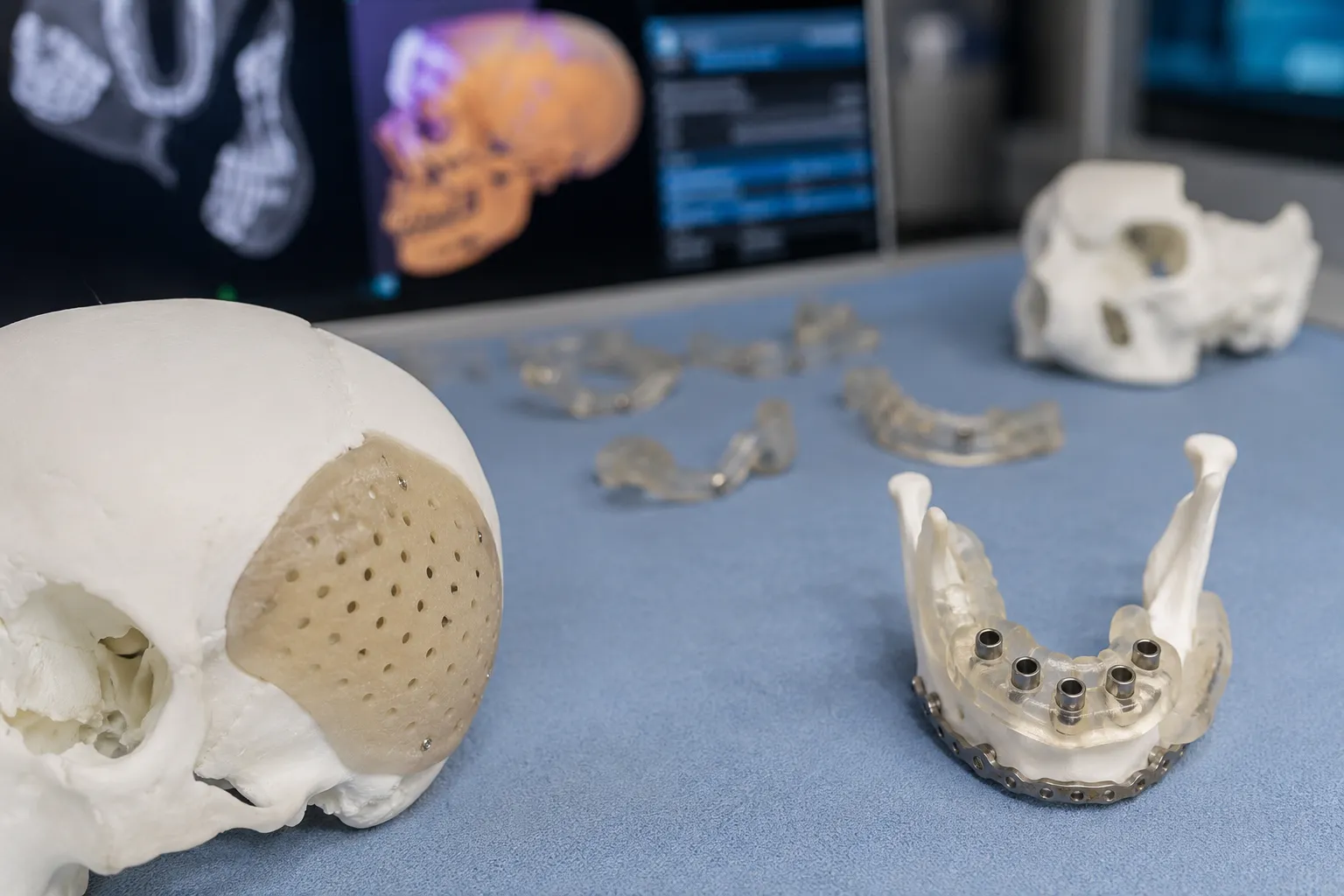
3D-assisted ENT surgery combines digital anatomical segmentation and modelling, patient-specific device design and additive manufacturing to enhance precision in the operating theatre. It relies in particular on:
- Detailed anatomical segmentation and modelling from clinical imaging (CT scans, MRI and CBCT)
- Computer-assisted planning to anticipate and optimise each surgical step.
- Design of patient-specific devices: implants, guides and surgical instruments
- Additive manufacturing (layer-by-layer 3D printing) of surgical guides, implants or prostheses.
- Use of biocompatible materials (titanium, polymers, resins) validated for medical use.
This approach makes it possible to adapt each procedure to the patient’s anatomy, while securing placement and reducing surgical risks.
How does 3D printing work in ENT surgery?
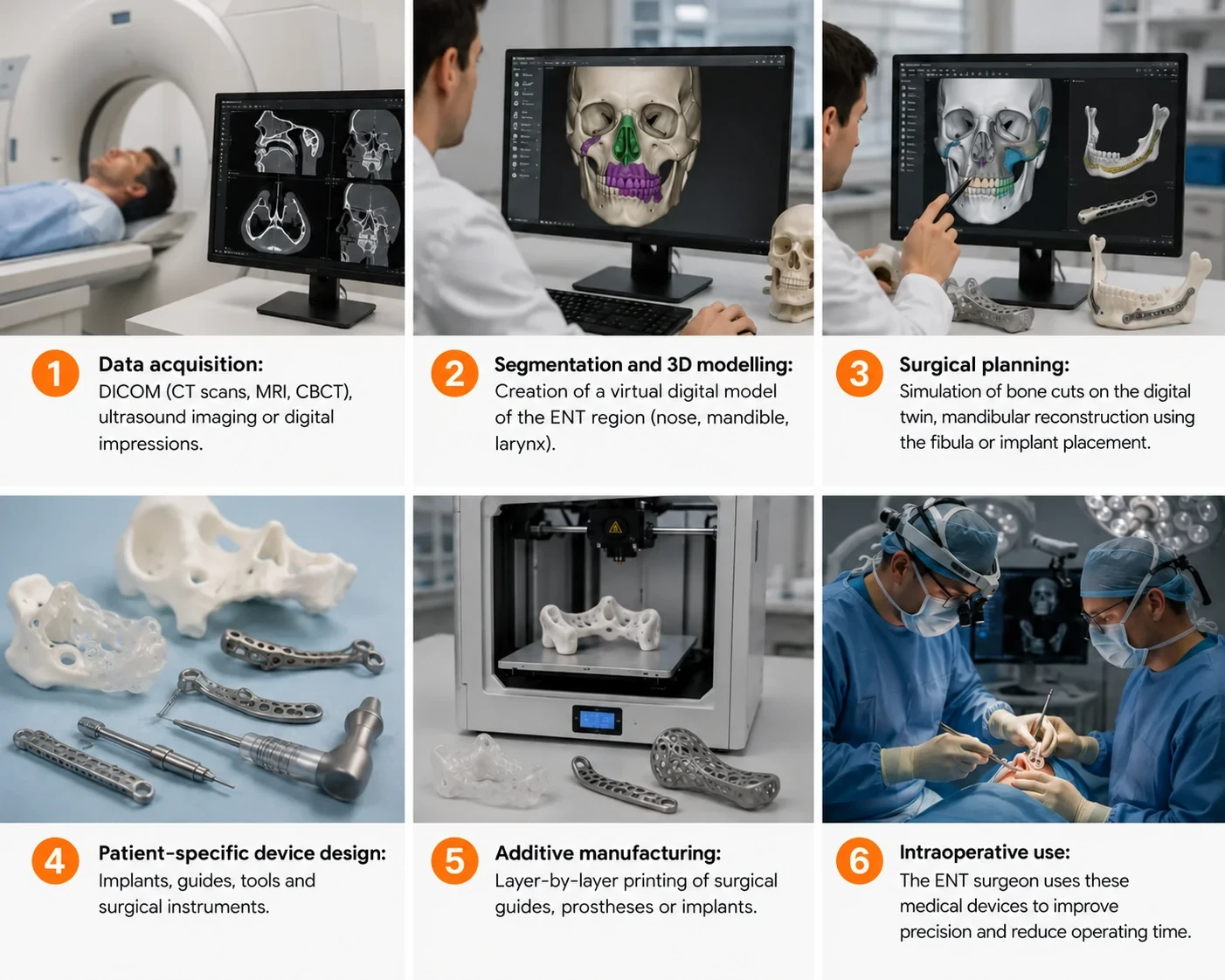
3D printing follows a structured digital workflow:
-
1
Data acquisition: DICOM (CT scan, MRI, CBCT), ultrasound imaging or digital impressions.
-
2
3D segmentation and modelling: creation of a virtual digital model of the ENT area (nose, mandible, larynx).
-
3
Surgical planning: simulation of bone cuts on the digital twin, mandibular reconstruction with fibula or implant placement.
-
4
Design of patient-specific devices: implants, guides, surgical tools and instruments
-
5
Additive manufacturing: layer-by-layer printing of surgical guides, prostheses or implants.
-
6
Use in the operating theatre: the ENT surgeon relies on these medical devices to improve precision and reduce operating time.
What types of ENT malformations can be treated?
3D ENT surgery is used in many clinical contexts, for example:
- Nasal reconstruction following trauma, cancer or endoscopic surgery.
- Mandibular reconstruction with titanium implants and plates.
Management of cervicofacial tumours and cancers, with upstream planning and manufacture of custom guides. - Correction of congenital malformations, including in paediatric ENT surgery.
How does a 3D ENT operation take place?
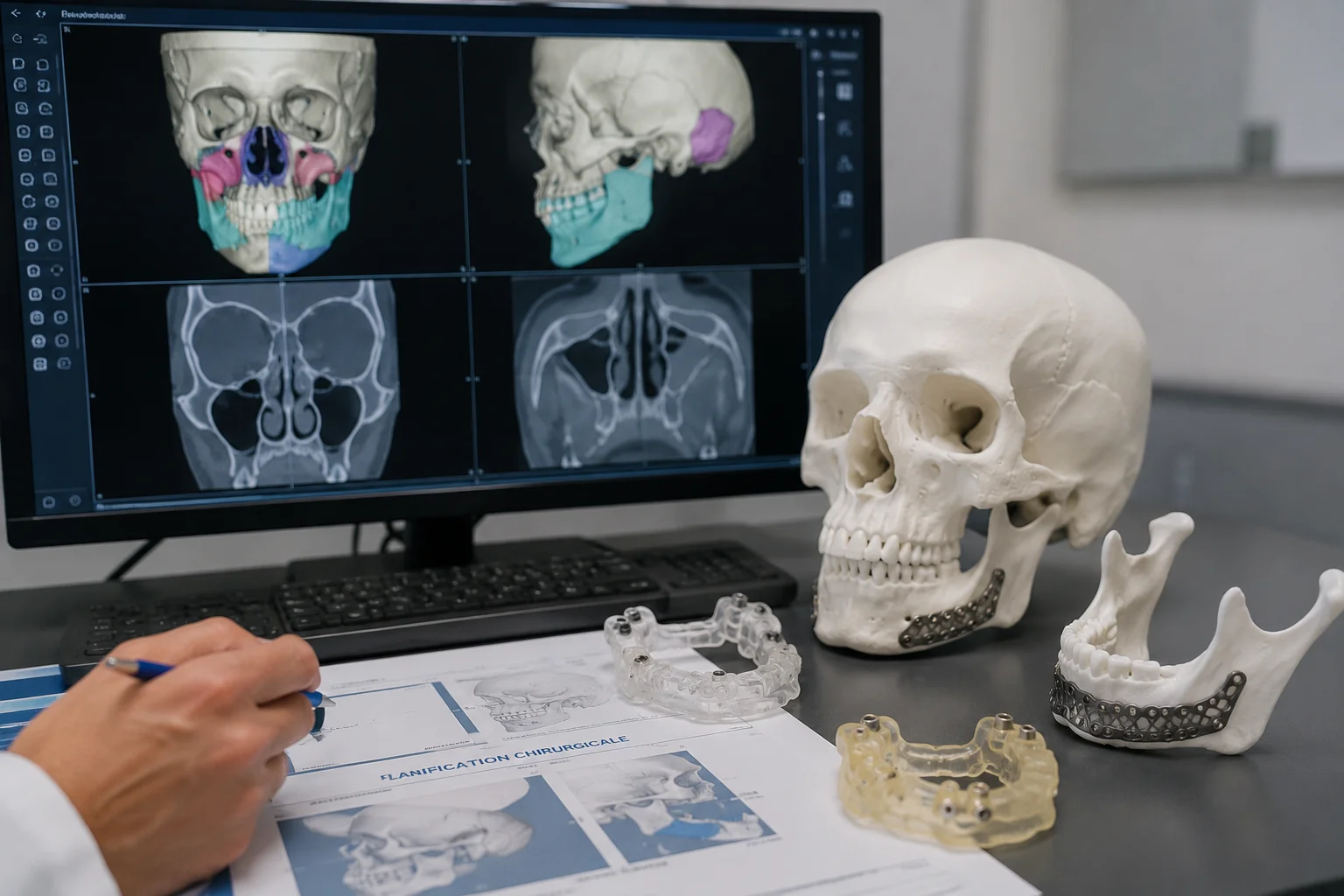
A 3D-assisted ENT operation follows several stages:
Digital planning
creation of a virtual treatment plan based on anatomical data.
Simulation
anticipating surgical steps, preparing bone cuts, manufacturing printed guides and implants.
Surgical procedure
guided placement in the operating theatre, with the help of navigation tools or surgical robotics.
Clinical follow-up
comparison of the actual result with the initial 3D model, with adjustments if necessary.
Which medical devices are used?
In surgery, several items of equipment and tools are used:
- Medical 3D printers for guides, implants and prostheses.
- High-definition 3D cameras and exoscopes for surgical visualisation.
- Navigation systems and robotic surgery to assist the surgical procedure.
- 3D planning software (medical CAD, patient-specific implant) to design and simulate the procedure.
These medical devices, validated by health authorities, guarantee safe practice.
What results can be expected from 3D ENT surgery?
The integration of 3D technologies in ENT brings several benefits:
- Enhanced functional outcomes: better breathing, chewing and speech.
- Improved aesthetic outcomes: harmonious reconstruction of the nose, jaw and face.
- Reduced operating time and surgical risks.
- More precise post-operative follow-up thanks to the comparison between the 3D model and the actual result.
Solutions offered by Twin 3D
Twin 3D supports ENT departments in hospitals and clinics (university hospitals, specialist centres, private institutions) with:
Certified software for surgical planning and anatomical modelling.
- Custom devices: surgical guides, mandibular implants, made-to-measure prostheses.
- Comprehensive support: training, technical support and follow-up for medical teams.
- Complete ecosystem: integration of our solutions with your software and equipment and/or access to our network of partners specialising in 3D printers, scanners and regulatory certification.
Our goal: to turn your clinical ENT projects into reliable, innovative solutions tailored to each patient, from planning through to placement in the operating theatre.
Solutions offered by Twin 3D

Specialist software

Robotic arms


Training courses
FAQ
Yes. Our solutions are built on standard formats (DICOM, STL, OBJ…), compatible with most medical scanners, 3D printers and equipment already in use in ENT departments.
Other medical and surgical specialties
They trust us








Book a demonstration
Twin 3D supports healthcare professionals in their medical 3D projects. Speak with an expert and discover our solutions during a demonstration.