
3D technologies and 3D printing applied to orthopaedic surgery
3D printing is profoundly transforming orthopaedic surgery. It makes it possible to design medical devices perfectly adapted to each patient’s anatomy, with a high level of precision and advanced pre-operative planning. Surgical planning, operative guides and patient-specific implants: this tailor-made approach strengthens the safety of surgical procedures, the reproducibility of techniques and clinical effectiveness.
At Twin 3D, we support orthopaedic surgeons and healthcare institutions in integrating these technologies, from the segmentation of medical imaging to clinical implementation in the operating theatre.
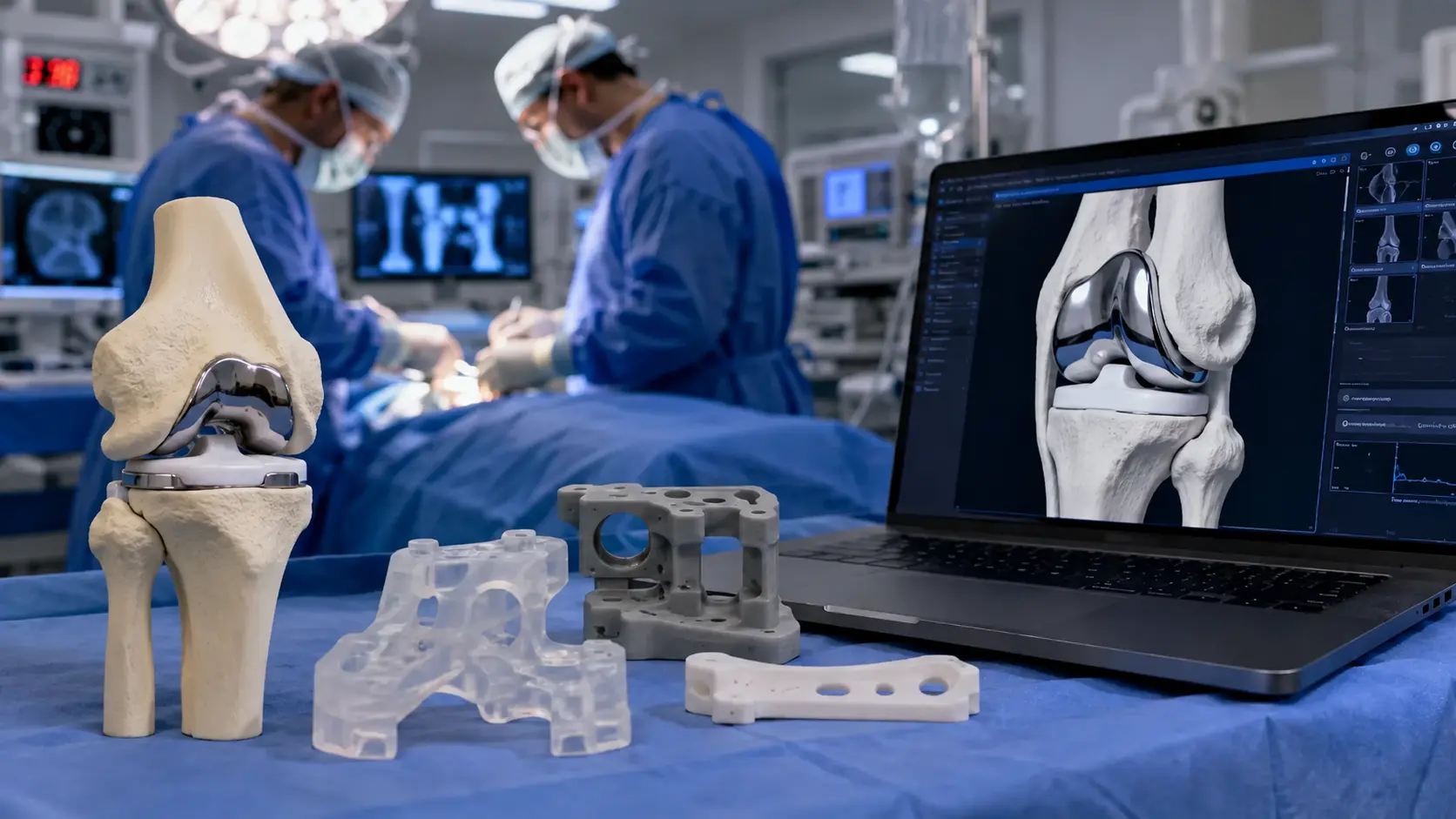
How is 3D printing revolutionising orthopaedic surgery?
Integrating 3D into orthopaedic surgery allows for more precise, better-anticipated operative preparation.
Using imaging data (CT scan, MRI, CBCT, etc.), anatomical segmentation faithfully reproduces the patient’s bone and joint structures. This digital modelling makes it possible to:
- obtain the patient’s digital twin,
- carry out surgical planning,
- simulate different operative strategies,
- optimise implant positioning,
- design tailor-made surgical guides.
Additive manufacturing then enables the rapid production of patient-specific guides and implants, reducing lead times and improving intra-operative precision.
The result: an optimised surgical workflow, shorter time in theatre, fewer revision procedures and better control of complex cases.
Practical applications in orthopaedic surgery
The applications bear directly on surgical practice:

Joint implants
patient-specific (hip, knee, shoulder, ankle) for optimal anatomical fit.

Surgical guides
personalised to facilitate osteotomies, drilling and the precise placement of implants.
Bone reconstruction
complex, following trauma, tumour or degenerative disease.

Revision surgery
requiring careful planning and suitable devices.

Anatomical models
printed for pre-operative planning, rehearsal of surgical procedures or patient information.
The digital process in orthopaedic surgery
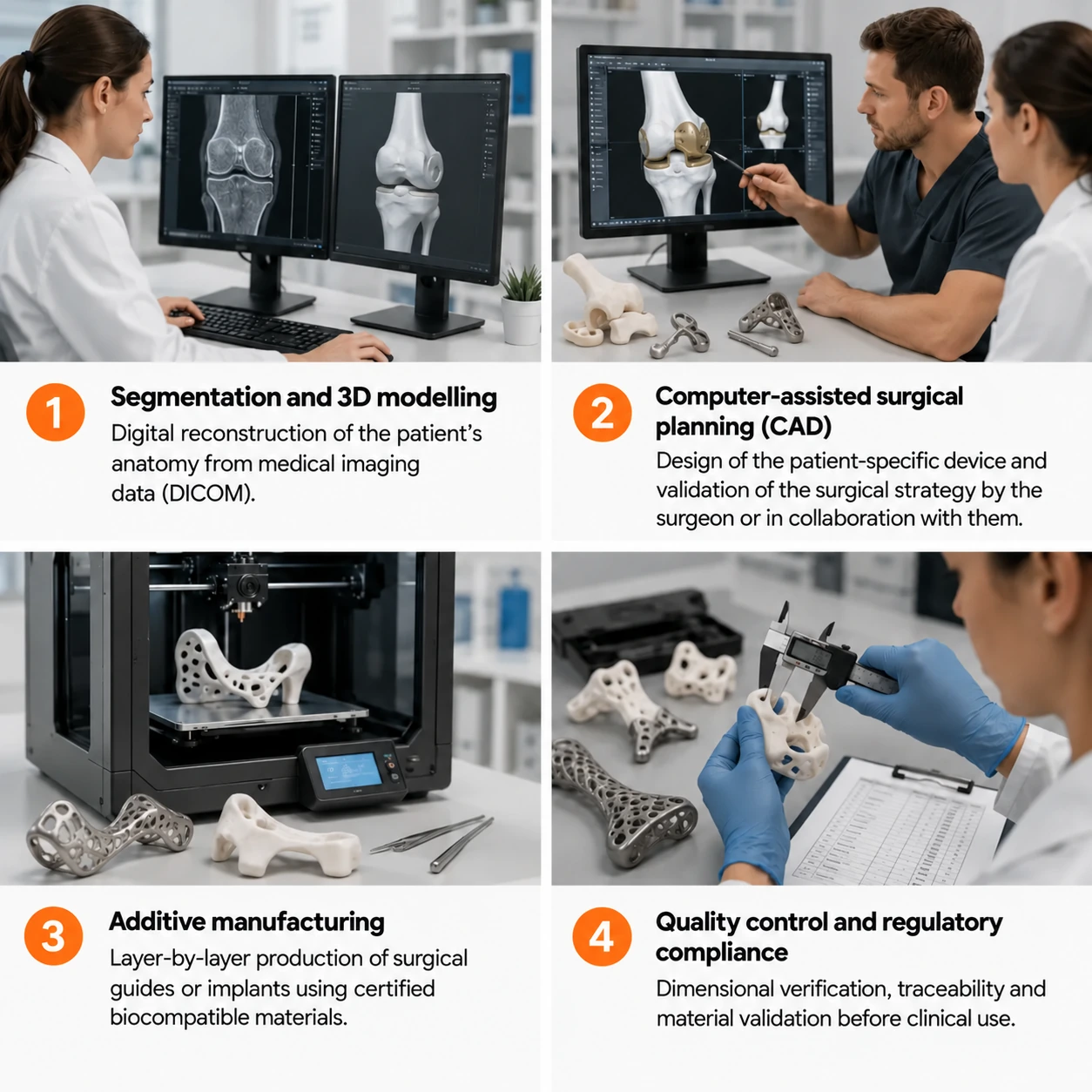
Orthopaedic surgery assisted by 3D printing relies on a structured workflow:
-
1
3D segmentation and modelling
Digital reproduction of the patient’s anatomy from their medical imaging (DICOM). -
2
Computer-aided surgical planning (CAD)
Design of the patient-specific device and validation of the operative strategy by the surgeon or in collaboration with them. -
3
Additive manufacturing
Layer-by-layer production of surgical guides or implants, using certified biocompatible materials. -
4
Quality control and regulatory compliance
Dimensional verification, traceability and validation of materials before clinical use.
Which devices can be produced?
In orthopaedic surgery, 3D printing makes it possible to produce:
- Patient-specific metal implants (titanium, cobalt-chrome, etc.),
- Personalised cutting and drilling guides,
- Bone reconstruction devices,
- Anatomical models for planning and surgical teaching.
Each device aims to improve operative precision and patient safety.
Which materials are used in orthopaedic surgery?
The choice of materials depends on the surgical indication:
- Titanium and cobalt-chrome: durable, biocompatible permanent implants.
- High-performance medical polymers: sterilisable surgical guides.
- High-precision technical resins: anatomical models and planning devices.
All the materials used meet the regulatory requirements applicable to medical devices.
The benefits in orthopaedic surgery
For the surgeon:
- optimised operative preparation,
- greater precision of surgical procedures,
- shorter time in theatre,
- standardisation of complex procedures.
For the patient:
- optimised operative preparation,
- greater precision of surgical procedures,
- shorter time in theatre,
- standardisation of complex procedures.
Challenges and outlook
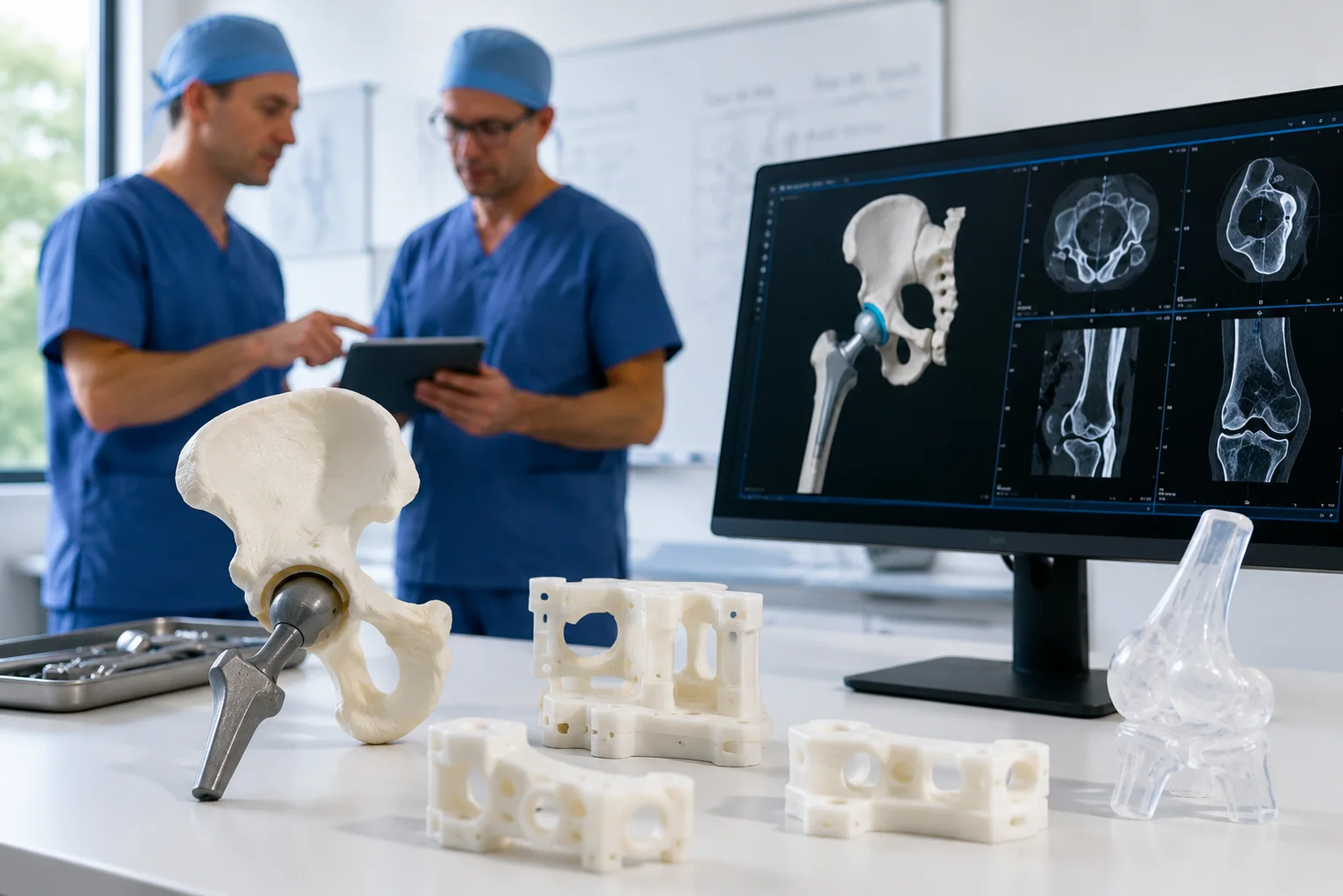
Integrating 3D printing into orthopaedic surgery requires compliance with strict regulations, staff training and adaptation of hospital workflows.
However, technological advances now position these solutions as a major driver in the evolution of personalised surgery.
The Twin 3D teams support healthcare institutions through this transition.
Solutions offered by Twin 3D
Twin 3D supports orthopaedic surgery departments with:
- certified software for segmentation, 3D modelling and
- surgical planning,
- the design of patient-specific guides and implants,
- comprehensive support, from planning to clinical implementation,
- the setting up of an automated digital chain to simplify and speed up adoption,
training dedicated to surgical teams.
Our goal: to make your procedures safer, optimise your surgical workflows and strengthen the quality of your care.
Solutions offered by Twin 3D

Specialist software



Robotic arms



Training courses
FAQ
From a few days for a surgical guide to several weeks for a complex implant supplied with its associated devices.
Other medical and surgical specialities
They trust us









Book a demonstration
Twin 3D supports healthcare professionals in their medical 3D projects. Speak with an expert and discover our solutions during a demonstration.