
3D printing applied to dental surgery
With the integration of 3D technologies, dental surgery is becoming more efficient. Digital modelling and 3D printing make it possible to create prostheses, splints and surgical guides tailored to the patient’s anatomy and pathology, for more precise and safer therapeutic and surgical procedures.
At Twin 3D, we support dental practices and maxillofacial surgeons with digital solutions and custom-made medical devices: surgical guides, anatomical models, implants and personalised prostheses.
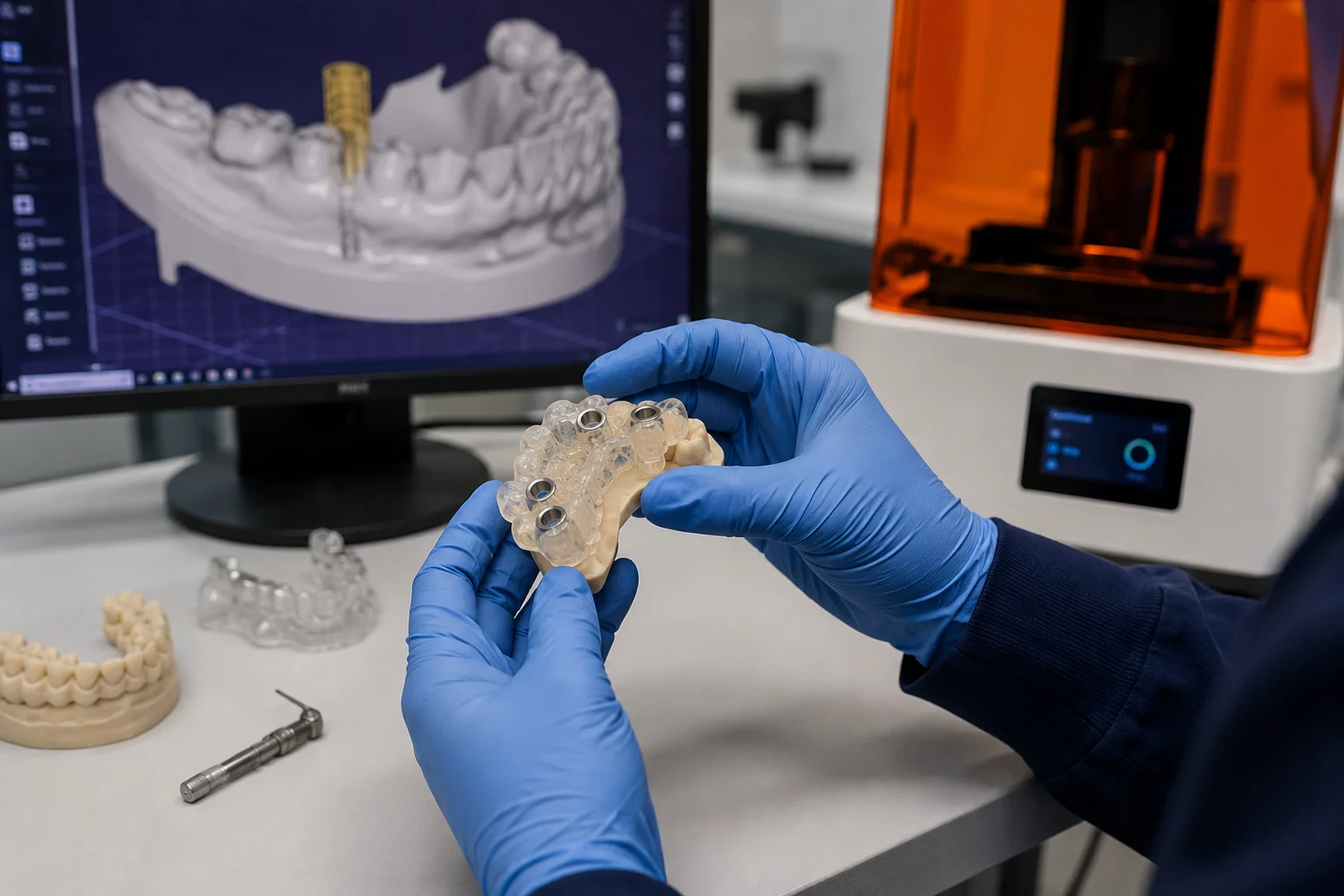
What are the benefits of dental 3D printing?
3D printing is transforming dental practice by providing:

Enhanced precision
faithful reproduction of the patient’s anatomy from digital data.

High quality
devices suited to mechanical and aesthetic requirements.

Personalisation
every prosthesis, splint, implant or surgical guide is custom-designed.

Time savings
optimised planning, fewer surgical complications.
Cost savings
fewer trials, less wasted material, better clinical efficiency.
Result: faster, safer care adapted to each patient.
How does 3D printing work in dentistry?
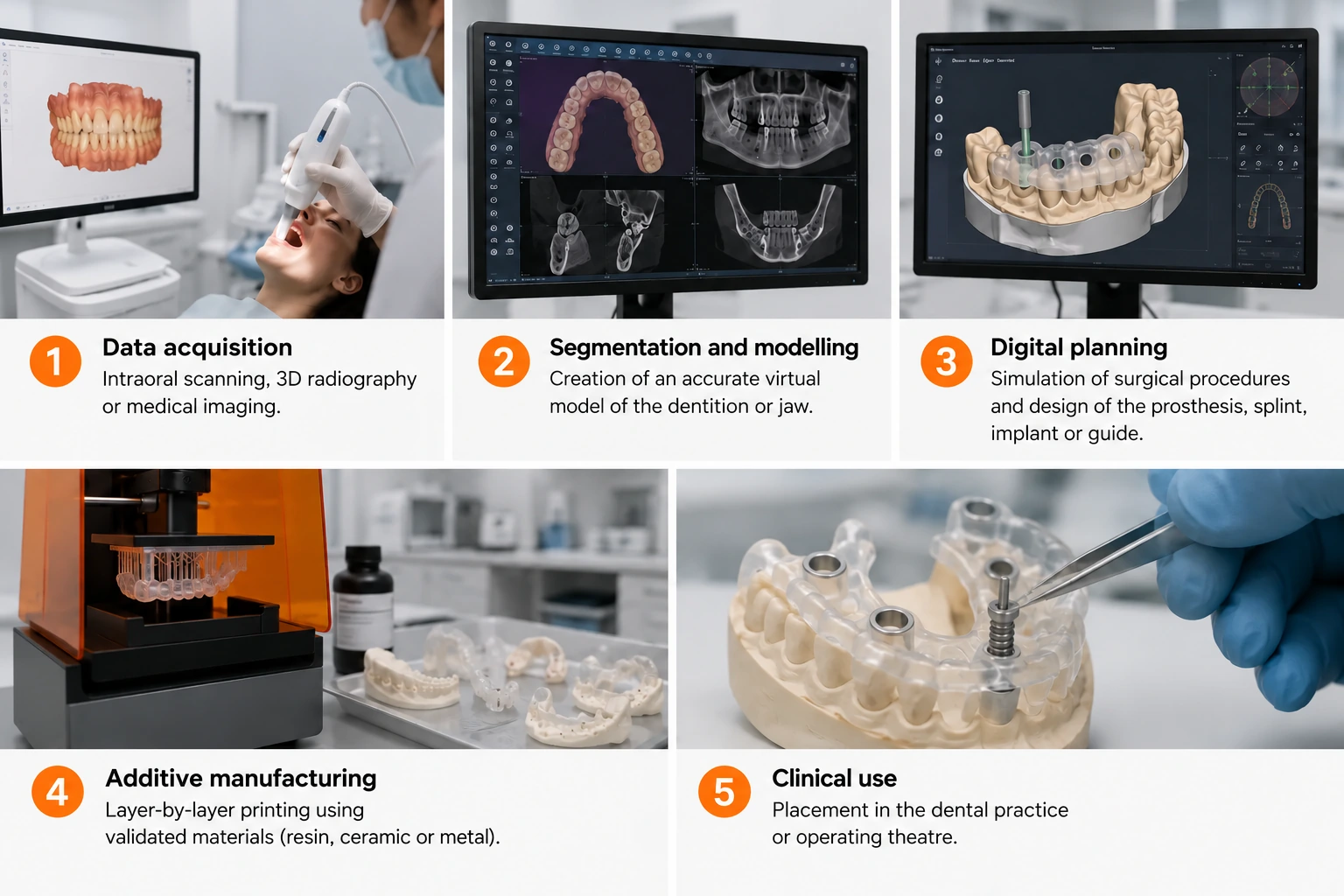
The digital workflow is based on a structured process:
-
1
Data acquisition: intraoral scanner, 3D radiography or medical imaging.
-
2
Segmentation and modelling: creation of an accurate virtual model of the teeth or jaw.
-
3
Digital planning: simulation of surgical procedures and design of the prosthesis, splint, implant or guide.
-
4
Additive manufacturing: layer-by-layer printing with validated materials (resin, ceramic, metal).
-
5
Clinical use: placement at the practice or in the operating theatre.
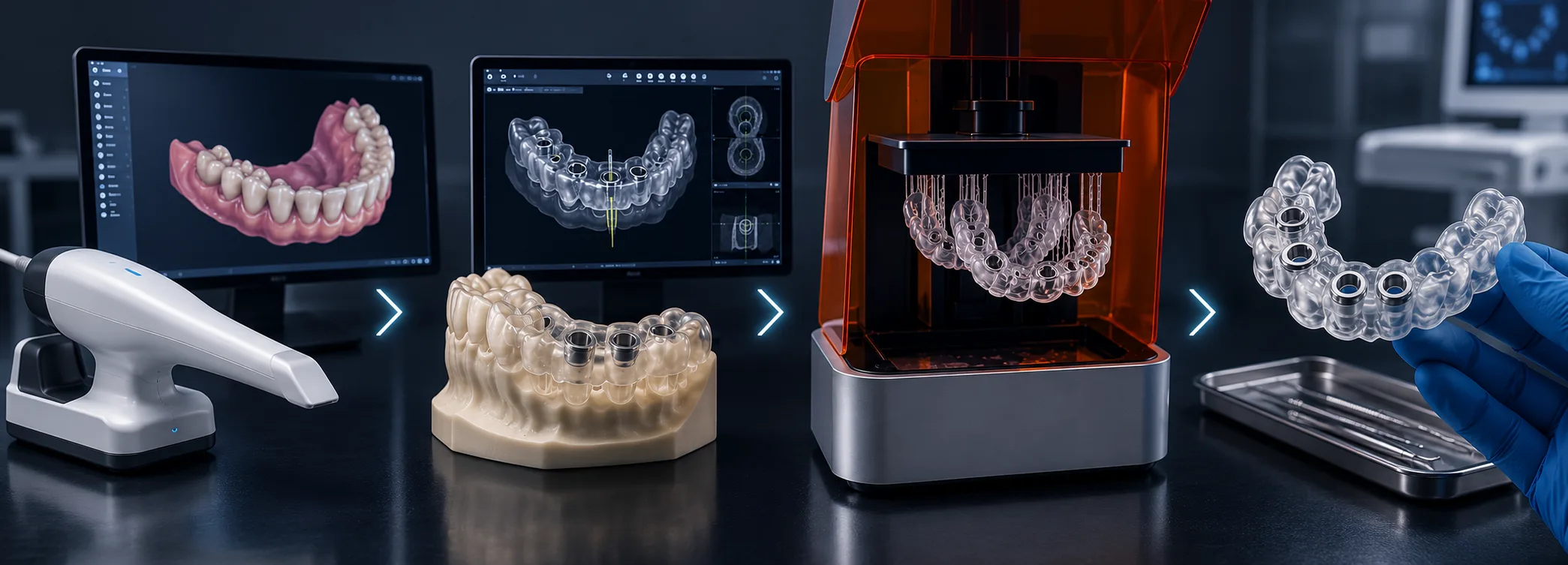
What are the clinical applications of 3D printing in dental surgery?
Uses vary according to needs:

Surgical guides
for implantology.

Dental prostheses
personalised (crowns, bridges, inlays, onlays).

Orthodontic aligners
transparent and well-fitting.

Anatomical models
for planning, rehearsing the surgical procedure and teaching.

Treatment aids
in maxillofacial surgery.
Which materials are used in dental 3D printing?
Dental 3D printing uses biocompatible materials suited to clinical use:
- Resin: high precision for surgical guides and splints.
- Metal (titanium, cobalt-chrome): durable implants and prostheses.
- Ceramic: aesthetic and long-lasting for crowns and veneers.
- Bioresorbable materials: temporary solutions that promote regeneration.
How can you integrate 3D printing into your dental practice?
Adopting 3D printing does not happen all at once: it is gradually integrated into the day-to-day running of a dental practice.
- Identify clinical needs: implantology, orthodontics, maxillofacial surgery, prostheses, etc.
- Define the digital workflow: data capture (intraoral scanner, 3D imaging), modelling, planning, manufacturing.
- Adapt internal organisation: choosing which cases to handle in 3D, fitting it into the practice schedule, coordinating with the laboratory or partner hospital.
- Train the teams: becoming familiar with digital tools, reading 3D models and preparing procedures.
- Assess the return on investment: time savings, fewer adjustments, patient satisfaction.
What does dental 3D printing cost?
The cost depends on the application:
- Surgical guides: a more economical solution than traditional manufacturing, with reduced operating time.
- Prostheses and splints: fewer trials and adjustments, optimising the overall budget.
- Software licence: Twin 3D offers suitable options (annual or perpetual).
Solutions offered by Twin 3D
Twin 3D supports dental surgeons and dental practices with:
Certified software for segmentation, 3D anatomical modelling, surgical planning and the design of patient-specific devices.
- Custom-made medical devices: surgical guides, anatomical models, orthodontic aligners, dental prostheses.
- Comprehensive support: installation, training, technical support, clinical follow-up and software updates.
- Complete ecosystem: integration of our solutions with your software and equipment and/or access to our network of partners specialising in 3D printers, scanners and regulatory certification.
Our goal: to make every treatment more precise, faster and safer.
Solutions offered by Twin 3D

Specialist software

Robotic arms


Training courses
FAQ
Yes. Twin 3D offers tailored training for dental surgeons and their teams, to integrate 3D printing effectively into the clinical workflow.
Depending on the software concerned, Twin 3D offers annual licences with updates included, or perpetual licences for long-term use. Floating licences are also available, allowing software use to be shared between different departments or professionals.
Yes. Our software works with standard formats (DICOM, STL, OBJ), which are compatible with intra-oral scanners and the equipment already in place in dental practices.
Enhanced precision, shorter treatment times, personalised devices, and optimised comfort, functional outcomes and aesthetic results.
Other medical and surgical specialties
They trust us








Book a demonstration
Twin 3D supports healthcare professionals in their medical 3D projects. Speak with an expert and discover our solutions during a demonstration.